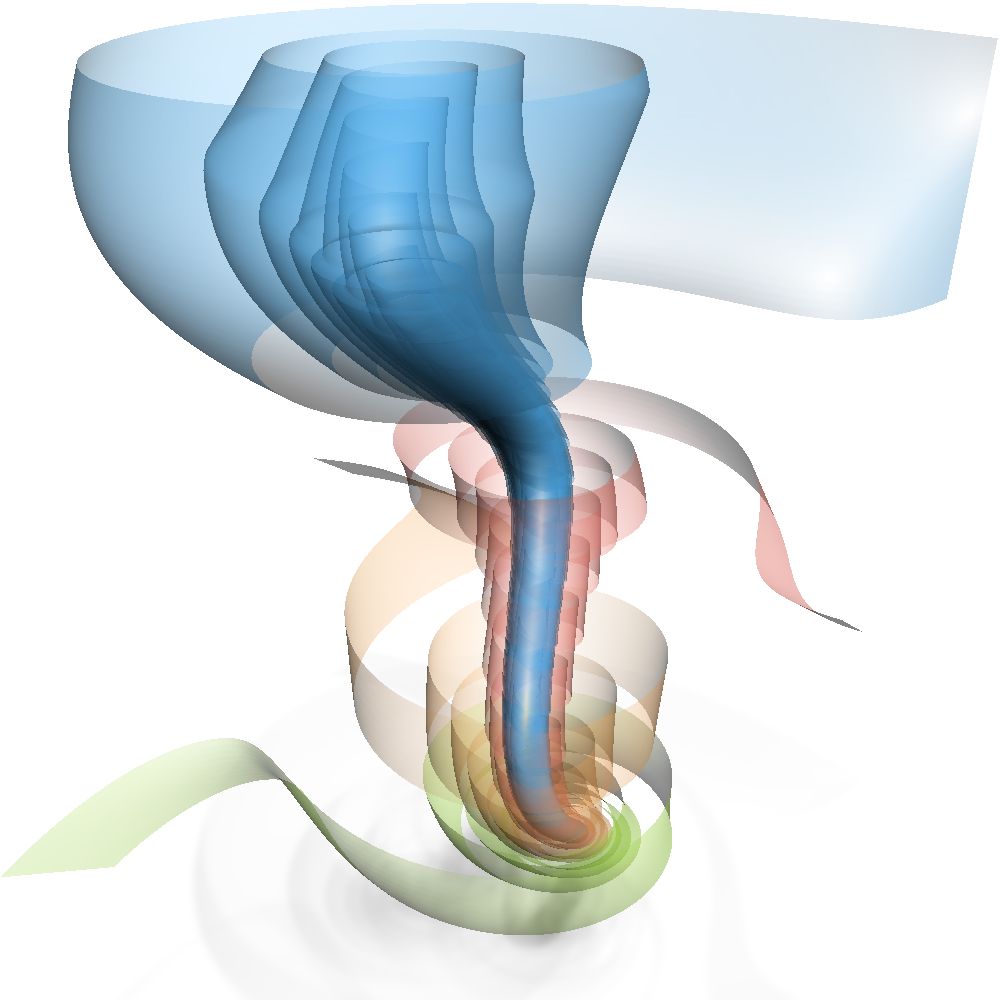
Our research is at the intersection of the natural sciences and of computer graphics. We develop feature extraction and visualization systems for scientists in various disciplines, including engineering, meteorology, climate science, geophysics, and fluid dynamics. Based on the mathematical foundations developed acrossed these fields, we research computer graphics simulations of natural phenomena, including light transport and electomagnetic waves.
Research Topics
Feature Extraction in Unsteady Flows
Our research is dedicated to novel extraction and rendering techniques for the visualization of features in unsteady flows. We apply techniques from light transport in heterogeneous participating media to the unbiased rendering of features in Lagrangian scalar fields. An example in atmospheric flows are the ridges of the finite-time Lyapunov exponent (FTLE), which constrain the advection of trace gases, guide temperature diffusion, and cloud formation.
Reference Frame Optimization
Vortex extraction is among the most challenging tasks of vector field analysis. We investigate elegant optimization-based approaches that extract vortices in an optimal near-steady reference frame. Vortex measures thereby become invariant under initial rotations and translations of the observer, i.e., they become objective.
Inertial Particle Dynamics
Recent research in flow visualization focused on the analysis of massless particles. However, in many application scenarios, the mass of particles and their resulting inertia are essential, for instance when sand particles interact with aircraft. The governing ordinary differential equation of even simple inertial flow models is up to seven dimensional. We extract and visualize integral geometry, study the vortical motion and separation behavior of inertial particles, and extend traditional vector field topology to the inertial case.
Visibility Optimization
When it comes to 3D flow visualization, we often encounter occlusion problems when displaying dense sets of points, lines or multiple surfaces. A vital aspect is the careful selection of the primitives that best communicate the relevant features in a data set. We investigate optimization-based approaches that adjust the opacity of points, lines and surfaces to strive for a balance between the presentation of relevant information and occlusion avoidance.
Smooth Vector Graphics
Conventional vector graphics formats are limited to simple color gradients. We develop novel techniques that allow artistic editing of complex color gradients, unifying two orthogonal threads of research: mesh-based and curve-based models. We thereby concentrate on the mathematical modeling and the efficient rendering of such scenes.
Monte Carlo Light Transport
Depending on the degree of realism, the computation of photo-realistic images can take some time. We investigate techniques to accelerate Monte Carlo rendering in order to provide faster feedback and more control for artists. Further, we explore real-time rendering solutions that efficiently mimic natural phenomena, such as interactive material aging simulations.
Privacy Settings
Our website uses cookies and similar technologies.
Some cookies are necessary for visiting this website, i.e. essential. Otherwise, without these cookies, your end device would not be able to remember your privacy choices, for example.
If you agree, we also use cookies and data to measure your interactions with our website or to integrate external media (e.g. videos).
You can view and withdraw your consent at any time at Privacy policy. On the site you will also find additional information about the cookies and technologies used.
Here you will find an overview of all cookies used. You can give your consent to whole categories or display further information and select certain cookies.